We post here the relevant reports for the power sector in Nigeria. Feel free to join our efforts and share us any other you may have found. We'd be glad to add them to the list. Just send an email to This email address is being protected from spambots. You need JavaScript enabled to view it.
Publication date: 2013, June
Author: Covenant University
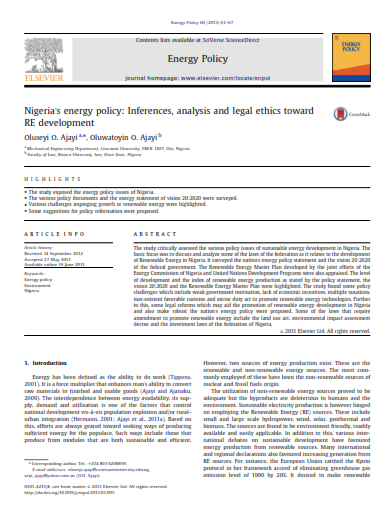
Description: The study critically assessed the various policy issues of sustainable energy development in Nigeria. The basic focus was to discuss and analyze some of the laws of the federationasit relates to the development of Renewable Energy in Nigeria. It surveyed the nation's energy policy statement and the vision 20:2020 of the federal government. The Renewable Energy Master Plan developed by the joint efforts of the Energy Commission of Nigeria and United Nations Development Programs were also appraised.
Download Report >>
Visit Website >>
Publication date: 2013, June
Author: Energy Commission of Nigeria
Description: Renewable Energy and Energy Efficiency Development in Nigeria.
Download Report >>
Publication date: 2013, June
Author: Energy Commission of Nigeria
Description: Brief of Energy Pricing Policy and Subsidy in Nigeria.
Download Report >>
Publication date: 2013, April
Author: Energy Commission of Nigeria
Description: Renewable Energy and the Transformation Agenda in Nigeria.
Download Report >>
Publication date: 2013, April
Author: Energy Commission of Nigeria
Description: Renewable Energy Education and Research Capabilities in Nigeria.
Download Report >>
Publication date: 2013, March
Author: Federal Ministry of Power
Description: Action Plan for the Large-scale Deployment of Renewable Energy Sources in Nigeria.
Download Report >>
Publication date: 2013, March
Author: NIPC
Description: Renewable Energy Investment in Nigeria: Risks and Incentives.
Download Report >>
Publication date: 2013, March
Author: Ahmadu Bello University
Description: An Overview of the 2nd Renewable Energy Master Plan for Nigeria.
Publication date: 2013, February
Author: Energy Commission of Nigeria
Description: Status of Energy Access in Nigeria.
Download Report >>
Publication date: 2013
Author: NERC
Description: In exercise of the powers to make Regulations conferred by Section 32(1) and 96 of the Electric Power Sector Reform Act 2005 (Act No. 6 of 2005), the Nigerian Electricity Regulatory Commission makes the following regulation on local content development for the Nigerian Electricity Supply Industry.
Download Report >>
Publication date: 2012, December
Author: LAUREA
Description: This thesis project research was conducted as part of the CONNECT project at Laurea University of Applied Sciences. The project concerns the investigation of the current renewable energy market entry and opportunities for Finnish small and medium-sized enterprises (SMEs) in the Nigerian economy. The goals is to support growth and accelerate the internationalization of small and medium-sized Finnish renewable energy companies within developing countries and to determine how they can achieve market entry in the renewable energy resource business in Nigeria.
Download Report >>
Visit Website >>
Publication date: 2012, December
Author: Energy Commission of Nigeria
Description: Renewable Energy Policy & Masterplan for Nigeria.
Download Report >>
Publication date: 2012, December
Author: Energy Commission of Nigeria
Description: Energy Sources and Sustainable Development of the North.
Publication date: 2012, November
Author: ECN / UNDP
Description: Renewable Energy Master Plan.
Download Report >>
Publication date: 2012, June
Author: Law Business Research
Description: The Nigerian Electricity Regulatory Commission (NERC), established under the Electric Power Sector Reform Act 2005 (EPSRA), regulates the Nigerian electricity industry. EPSRA is the legal framework for the electricity industry. Through EPSRA, the FGN unbundled and privatised the then state-owned monopoly, the National Electric Power Authority (NEPA) into the Power Holding Company of Nigeria, generation companies (Gencos), distribution companies (Discos) and the Transmission Company of Nigeria (TCN).
Download Report >>
Publication date: 2012, January
Author: ResearchGate
Description: Hydropower currently makes about 20% contribution to the global electricity supply, second to fossil fuel and it is one of the cleanest and most reliable sources of energy. Nigeria is endowed with enormous hydropower potential that needs to be harnessed. Despite this huge potential which is enough to meet all the electricity needs of the country, only a small fraction has been exploited.
Download Report >>
Visit Website >>
Publication date: 2012
Author: iied
Description: Renewable energy has considerable potential in Nigeria, and could bridge the major energy gaps in rural areas, particularly northern Nigeria. The scale of opportunities is only just becoming apparent as new grid technologies such as concentrated solar power are emerging as in competitors with conventional power generation. This report discusses energy sector in Nigeria and recommends action for harnessing the country's renewable energy potential.
Download Report >>
Publication date: 2012
Author: Federal Ministry of Power
Description: This document, produced by the Nigerian Ministry of Power, gives a step-by-step guide to investors looking to come into any portion of the Nigerian Electricity Supply Industry.
Download Report >>
Publication date: 2012
Author: NERC
Description: In exercise of the Powers to make regulations conferred by Section 96(1) of the Electric Power Sector Reform Act 2005 (Act No.6 of 2005), the Nigerian Electricity Regulatory Commission makes the following regulations for Independent Electricity Distribution Network (IEDN) 2012.
Download Report >>
Visit Website >>
Publication date: 2012
Author: Covenant University
Description: The concerns for environmental sustainability have become the subjects of global discussion. This has prompted debates, negotiations, declarations and legislations world over. The outcome of these engagements has favoured the reduction of anthropogenic emissions that are deleterious to the environment and at the same time promote environmental sustainability in the face of economic development. One of the major sources of anthropogenic emissions has been linked to energy production.
Download Report >>
Visit Website >>