fbpx

Ghana

We post here the relevant reports for the power sector in Ghana. Feel free to join our efforts and share us any other you may have found. We'd be glad to add them to the list. Just send an email to This email address is being protected from spambots. You need JavaScript enabled to view it.


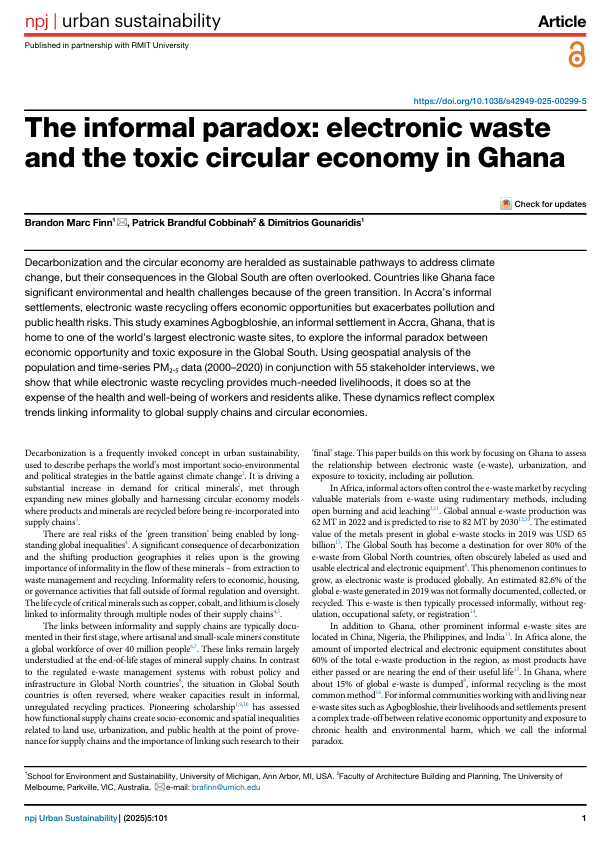
Publication date: 3 December 2025

Author: npj Urban Sustainability

Description: Decarbonization and the circular economy are heralded as sustainable pathways to address climate change, but their consequences in the Global South are often overlooked. Countries like Ghana face significant environmental and health challenges because of the green transition. In Accra’s informal settlements, electronic waste recycling offers economic opportunities but exacerbates pollution and public health risks. This study examines Agbogbloshie, an informal settlement in Accra, Ghana, that is home to one of the world’s largest electronic waste sites, to explore the informal paradox between economic opportunity and toxic exposure in the Global South. Using geospatial analysis of the population and time-series PM₂.₅ data (2000–2020) in conjunction with 55 stakeholder interviews, we show that while electronic waste recycling provides much-needed livelihoods, it does so at the expense of the health and well-being of workers and residents alike. These dynamics reflect complex trends linking informality to global supply chains and circular economies.

            Download Report >>

            Visit Website >>

Publication date: 26 November 2025

Author: CGIAR

Description: Collective action among smallholder farmers enhances resource mobilization and addresses challenges beyond individual capacity. In Northern Ghana, farmers collaborate in formal and informal groups to strengthen their farming activities. While collective investment in irrigation has improved yields, income, and nutrition, the solar-based irrigation supply chain often overlooks farmer groups and cooperatives. To address this gap, this study applies a mixed-method analysis of collective investment models in solar-based irrigation bundles (SBIBs). Collective irrigation investment (CI-in) is a form of collective action by farmer-based organizations, involving voluntary risk-taking to achieve shared irrigation goals. CI-in supports cost-sharing, commercialization of irrigated farming, and better access to resources, technical assistance, and market information (Filippi et al. 2022). SBIBs integrate core products (e.g., solar pumps, boreholes, water application equipment), financial services (e.g., pay-as-you-go/ pay-as-you-own: PAYGO and PAYOWN are financial services designed to reduce upfront investment costs for farmers. PAYOWN allows farmers to buy solar-powered irrigation pumps through flexible installment plans until full ownership is achieved, whereas PAYGO provides water access on credit, with the pump operating only when payments are made, digital payments, tailored business models, sales and service networks), complementary services (extension, capacity strengthening, market linkages, storage and processing facilities), and scaling actions to meet diverse farmer needs.

            Download Report >>

            Visit Website >>

Publication date: 9 July 2025

Author: BMC Public Health

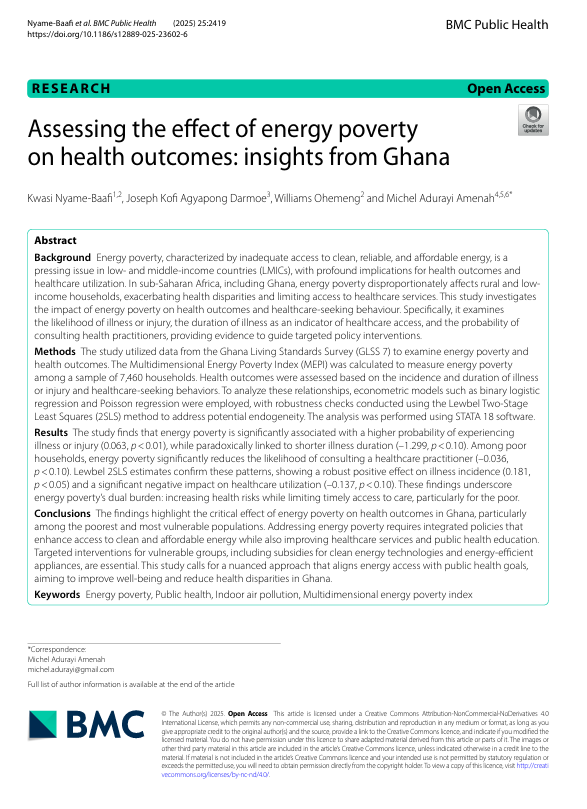
Description: Energy poverty, characterized by inadequate access to clean, reliable, and affordable energy, is a pressing issue in low- and middle-income countries (LMICs), with profound implications for health outcomes and healthcare utilization. In sub-Saharan Africa, including Ghana, energy poverty disproportionately affects rural and low-income households, exacerbating health disparities and limiting access to healthcare services. This study investigates the impact of energy poverty on health outcomes and healthcare-seeking behaviour. Specifically, it examines the likelihood of illness or injury, the duration of illness as an indicator of healthcare access, and the probability of consulting health practitioners, providing evidence to guide targeted policy interventions.

            Download Report >>

            Visit Website >>

Publication date: 2025

Author: Danish Institute for International Studies (DIIS)

Description: Despite Ghana’s explicit plans to deploy mini-grids for the electrification of off-grid and remote communities, progress has been slow. This paper explores how political dynamics and policy shifts have shaped the governance of mini-grids over time. It examines the evolution of mini-grids in Ghana in three phases: preliminary design stage (2007–2013); active implementation period, marked by policy modifications (2013– 2019); and subsequent consolidation under a predominantly public-led model post2019. Guided by an adapted political settlements framework and process tracing methodology, the paper argues that misalignment between the government of Ghana and donors over governance and ownership models, mediated by the country’s competitive clientelist politics, explains Ghana’s limited progress in the development of mini-grids. The paper provides nuanced insights into the complex ways transnational factors and domestic politics interact in shaping the development of mini-grids with wide implications for debates on energy governance and reform in sub-Saharan Africa..

            Download Report >>

            Visit Website >>

Publication date: June 2024

Author: Elsevier

Description: Access to energy is linked to poverty reduction and economic growth. However, electricity access rates in Africa have been very low despite recording progressive declines of people without access over the past decade. To achieve SDG 7, there is a need to provide electricity to people without access, the majority of whom live in Africa. Prepaid metering, being implemented in many African countries, is anticipated as a system to enhance electricity access and to ensure revenue is recovered successfully.

            Download Report >>

            Visit Website >>

Publication date: June 2024

Author: University of Aberdeen

Description: The study explores the effect of women’s empowerment on energy poverty in Ghana. Specifically, using data from the Ghana Living Standards Surveys administered in the years 1998/99, 2005/06, 2012/13 and 2016/17, and employing the ordered probit, multinomial probit, OLS and 2SLS-IV regressions, the study finds that households managed by female are more likely to use cleaner types of cooking fuel than male-headed households. Within the sub-sample of female-headed households, both de jure (absolute controlled) and de facto (partial controlled) female-headed households are more likely to use cleaner types of cooking fuel than their male-headed counterparts. However, the magnitude, at least in the case of firewood, is higher for de jure than de facto female heads, suggesting that the level of female empowerment in household potentially matters in reducing energy poverty. An analysis on household expenditure, reveals that female-headed households prioritise household food expenditure over expenditure on non-essential (such as alcohol, tobacco, and narcotics), compared to male-headed households. Avoiding expenditures on non-essentials (alcohol, tobacco, and narcotics) seems to help in the adoption of cleaner cooking fuel in female-headed households.

            Download Report >>

            Visit Website >>

Publication date: January 2024

Author: Elsevier

Description: Access to reliable electricity remains a significant challenge in many rural communities worldwide. Off-grid solar PV hybrid renewable energy systems (HRES) have emerged as a viable option for rural electrification. However, rural communities' lack of productive load often limits their effectiveness. This study aimed to assess the impact of agro-processing productive loads on the performance of off-grid solar PV HRES for rural electrification. Hybrid Optimization Multiple Energy Resource (HOMER) software was used to perform a techno-economic analysis of a solar PV/diesel HRES. The study findings showed improvement in the rural community's load factor and solar load correlation with the integration of the productive load. Subsequently, increasing the renewable energy fraction in solar PV/diesel HRES reduces the levelized cost of energy (LCOE), making electricity generation more cost-effective for rural electrification in Ghana. Comparatively, the improved LCOE was found to be substantially higher than the End User Tariff of all residential consumers on the national grid, even under high PV penetration and full capital cost subsidy cases. The study provides valuable insights into the role of agro-based productive loads in enhancing the performance of rural off-grid solar HRES.

            Download Report >>

            Visit Website >>

Publication date: July 2023

Author: ACEP / Oxfam

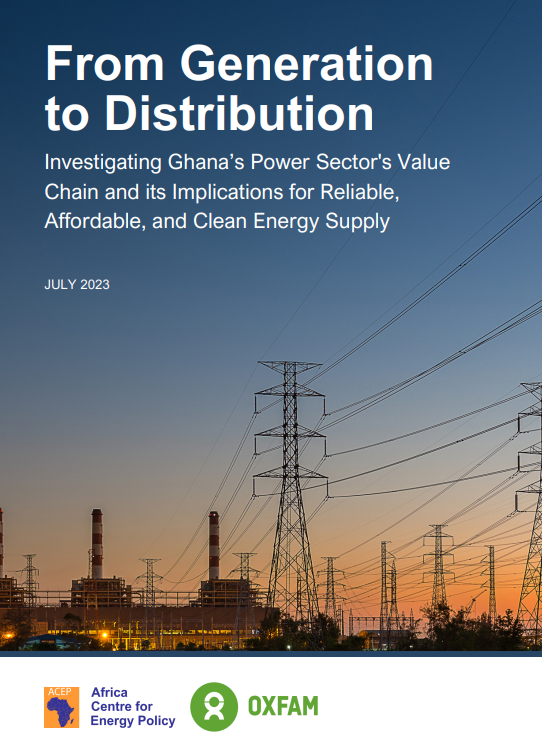
Description: The power sector’s role in economic growth is underscored by its function in providing stable electricity. The government manages a significant portion of the sector’s interconnected transmission networks and oversees policy direction and regulation. Thus, its actions or inactions government can change the trajectory of the power sector due to its multifaceted oversight responsibilities.

            Download Report >>

            Visit Website >>

Publication date: 17 March 2023

Author: Elsevier

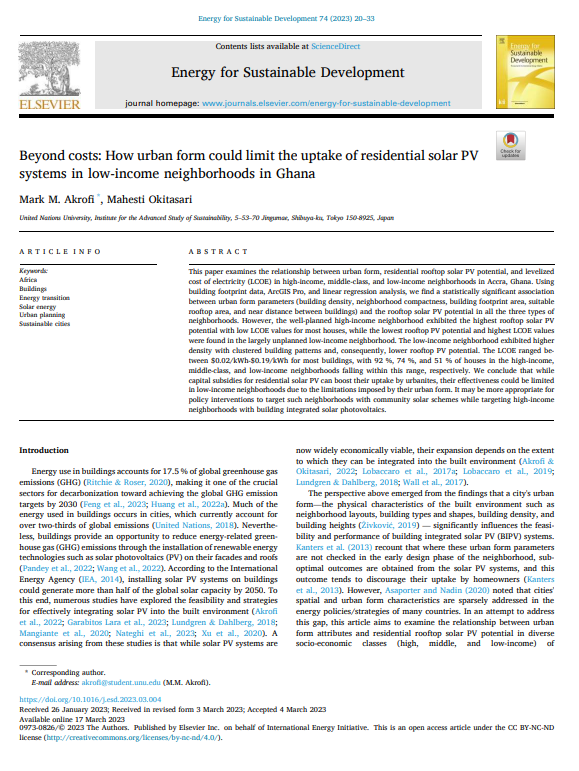
Description: This paper examines the relationship between urban form, residential rooftop solar PV potential, and levelized cost of electricity (LCOE) in high-income, middle-class, and low-income neighborhoods in Accra, Ghana. Using building footprint data, ArcGIS Pro, and linear regression analysis, we find a statistically significant association between urban form parameters (building density, neighborhood compactness, building footprint area, suitable rooftop area, and near distance between buildings) and the rooftop solar PV potential in all the three types of neighborhoods. However, the well-planned high-income neighborhood exhibited the highest rooftop solar PV potential with low LCOE values for most houses, while the lowest rooftop PV potential and highest LCOE values were found in the largely unplanned low-income neighborhood.

            Download Report >>

            Visit Website >>

Publication date: 15 May 2022

Author: AIMS Energy

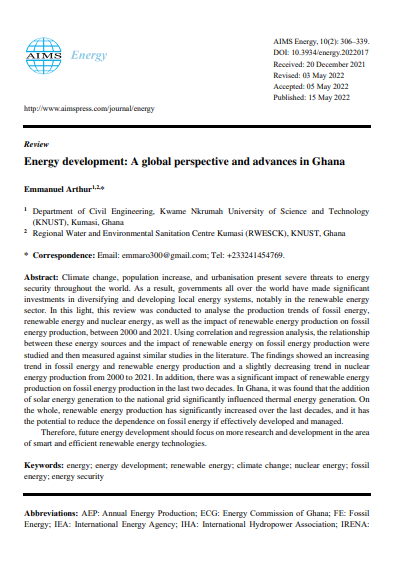
Description: Climate change, population increase, and urbanisation present severe threats to energy security throughout the world. As a result, governments all over the world have made significant investments in diversifying and developing local energy systems, notably in the renewable energy sector. In this light, this review was conducted to analyse the production trends of fossil energy, renewable energy and nuclear energy, as well as the impact of renewable energy production on fossil energy production, between 2000 and 2021.

            Download Report >>

            Visit Website >>

Publication date: March 2021

Author: Elsevier

Description: Public Private Partnerships (PPPs) have been used as a viable tool to accelerate infrastructural development in many countries. In recent years, the repercussions of climate change have heightened the need to adopt cleaner energy sources such as solar. Ghana has attempted investments in solar energy for obvious advantages such as ensuring energy security, cost advantage and expansion of rural electrification.

            Download Report >>

            Visit Website >>

Publication date: March 2021

Author: Elsevier

Description: Sub-Saharan Africa is a region with a large population living without electricity. This study investigates the grid balancing role of bioenergy in a sub-Saharan Africa’s fully renewable power sector to address the energy poverty challenge in the region, using Ghana as a case country. Two methods are employed: the bioenergy estimation method, for deriving Ghana’s technical bioenergy potential, and the LUT model, for the power sector transition modelling.

            Download Report >>

            Visit Website >>

Publication date: February 2021

Author: Tetra Tech International Development

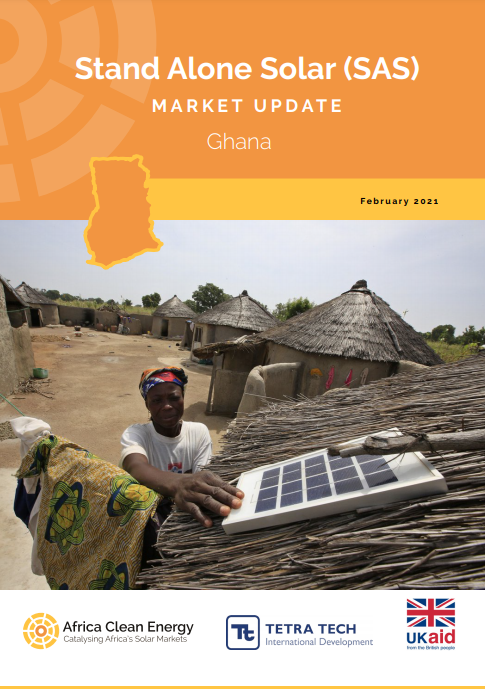
Description: The COVID-19 pandemic has slowed the progress made in recent years to increase access to affordable and reliable electricity in Ghana. The health crisis has forced the government to shift its immediate priorities to emergency measures, including pledging USD100 million to the COVID-19 Preparedness and Response Plan and other response measures. This reprioritisation is within the context of a shortfall in petroleum receipts, import duties and tax revenues, which has reduced available financing to expand and improve electricity infrastructure. Other concerns may be due to the cost of the preparedness plan itself, and the Coronavirus Alleviation Programme which will cost the economy about GH₵ 9.5 billion (USD1.62 billion).

            Download Report >>

            Visit Website >>

Publication date: 21 January 2021

Author: Elsevier

Description: There is a divide in energy access studies, between technologically-focused modeling papers in engineering and economics, and energy justice frameworks and principles grounded in social sciences. Quantitative computational models are necessary when analyzing energy, and more specifically electricity, systems, as they are technologically-complex systems that can diverge from intuitive patterns.

            Download Report >>

            Visit Website >>

Publication date: 2017

Author: MoP / EC

Description: In recent years, off-grid small-scale renewable energy technologies, particularly, solar PV systems have emerged as the plausible intervening solution for rural electricity supply in Ghana. However, the emerging solar PV solutions are exposed to the problem of being sustainable: after government and developing partners pull-out and hand over project to local users, the project only last few years of their life span.

            Download Report >>

            Visit Website >>

Publication date: 2016, September

Author: Power Africa

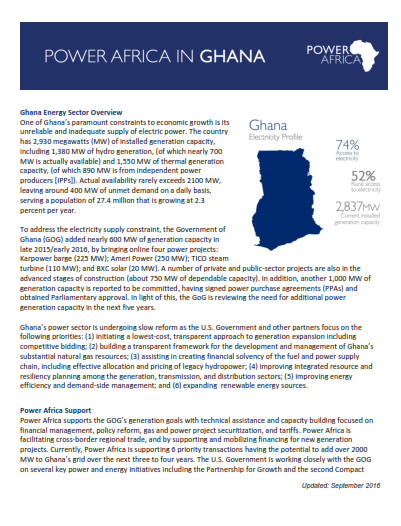
Description: One of Ghana’s paramount constraints to economic growth is its unreliable and inadequate supply of electric power. The country has 2,930 megawatts (MW) of installed generation capacity, including 1,380 MW of hydro generation, (of which nearly 700 MW is actually available) and 1,550 MW of thermal generation capacity, (of which 890 MW is from independent power producers [IPPs]).

            Download Report >>

Publication date: 2016, August

Author: MoP

Description: Ghana is a west Africa country bounded by Burkina Faso on the North, on the East by Togo and the West by Cote d'Ivoire and on the south of the Atlantic Ocean.

            Download Report >>

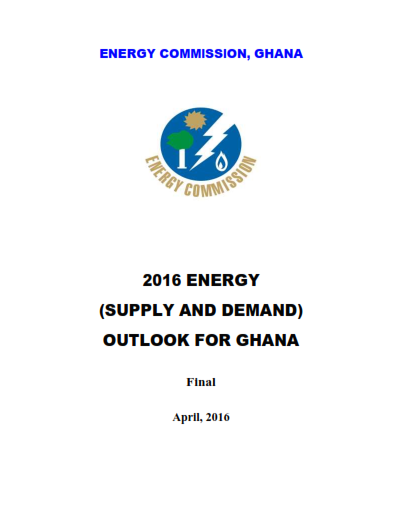
Publication date: 2016, April

Author: Energy Commission

Description: Energy Commission presents supply and demand forecasts for electricity, crude oil, petroleum products, natural gas and charcoal for the year 2016. Factors that could influence the demand and supply are also discussed.

            Download Report >>

STRATEGIC PARTNERS

Spintelligent
SAAEA
Pennwell
ALER

MEDIA PARTNERS

Renewables Now

EVENT PARTNERS

Africa Energy Forum
Future Energy East Africa
Future Energy Nigeria
Electricx
POWER-GEN Africa
Africa Energy Indaba 2020

Nairobi, KENYA

  • Email: info@africanpowerplatform.org
  • Phone: +254 736 692 876

Newsletter

Search