fbpx

Kenya

We post here the relevant reports for the power sector in Kenya. Feel free to join our efforts and share us any other you may have found. We'd be glad to add them to the list. Just sent an email to This email address is being protected from spambots. You need JavaScript enabled to view it.


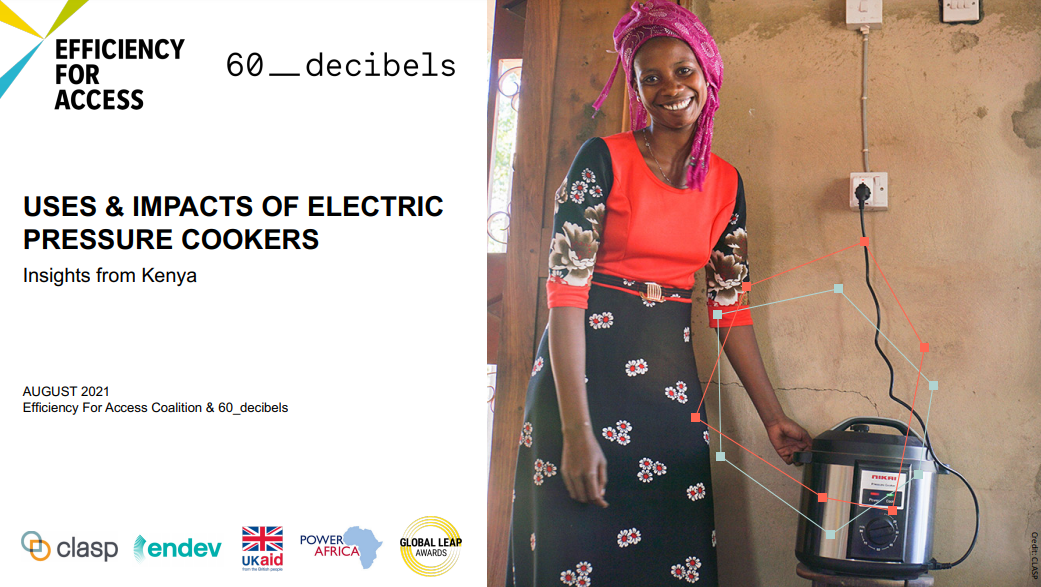
Publication date: August 2021

Authors: Efficiency For Access Coalition & 60_decibels

Description: Four billion people around the world still lack access to affordable, clean, efficient and safe cooking energy. Of these, 1.25 billion are transitioning to use modern cooking services, while the rest face high barriers to adoption.

Between May and October 2020, a Global LEAP results-based financing pilot facilitated the procurement of 4,806 electric pressure cookers (EPCs) in Kenya, sold to households by 6 participating distributors. As the market for EPCs is relatively nascent, Kenya was selected as the target geography for the pilot due to the presence of early-mover EPC distributors, electrification rates, as well as the cost of fuel.

This report presents the results of the research carried out by the 60 Decibels team through 400 phone interviews on the impact and experience of EPC customers. This study aims to provide deeper insights into the impact of first-time appliance ownership.

            Download Report >>

             Visit Website >>
Publication date: August 2021

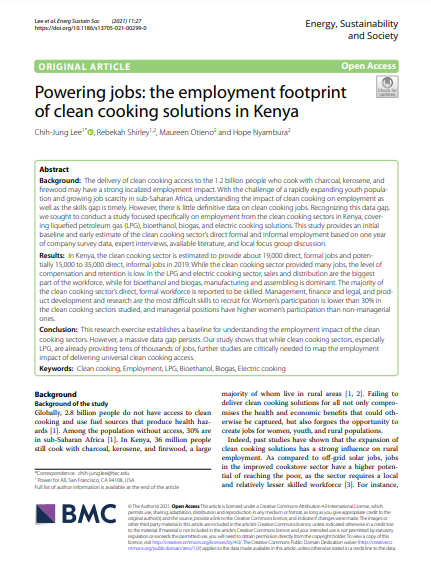
Author: BMC

Description: The delivery of clean cooking access to the 1.2 billion people who cook with charcoal, kerosene, and firewood may have a strong localized employment impact. With the challenge of a rapidly expanding youth population and growing job scarcity in sub-Saharan Africa, understanding the impact of clean cooking on employment as well as the skills gap is timely. However, there is little definitive data on clean cooking jobs. Recognizing this data gap, we sought to conduct a study focused specifically on employment from the clean cooking sectors in Kenya, covering liquefied petroleum gas (LPG), bioethanol, biogas, and electric cooking solutions. This study provides an initial baseline and early estimate of the clean cooking sector's direct formal and informal employment based on one year of company survey data, expert interviews, available literature, and local focus group discussion.

            Download Report >>

             Visit Website >>
Publication date: July 2021

Authors: Energy Research & Social Science

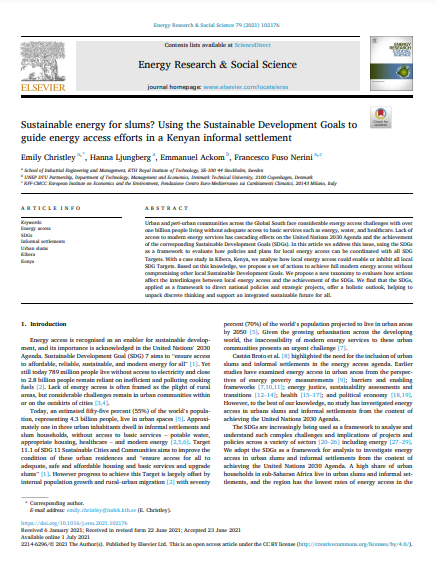
Description: Urban and peri-urban communities across the Global South face considerable energy access challenges with over one billion people living without adequate access to basic services such as energy, water, and healthcare. Lack of access to modern energy services has cascading effects on the United Nations 2030 Agenda and the achievement of the corresponding Sustainable Development Goals (SDGs). In this article we address this issue, using the SDGs as a framework to evaluate how policies and plans for local energy access can be coordinated with all SDG Targets. With a case study in Kibera, Kenya, we analyse how local energy access could enable or inhibit all local SDG Targets.

            Download Report >>

             Visit Website >>
Publication date: 27 May 2021

Authors: RAFLL and Shell Foundation

Description: Understanding how rural households and their needs might evolve over time is fundamental to providing better products and services to these clients—and to designing more inclusive rural economic development strategies. The introduction of the Rural Pathways Model in Pathways to Prosperity was an important step forward in thinking more dynamically about rural households. This model laid out seven different Pathways that rural households might take as they pursue different livelihood strategies and seek to increase their incomes, resilience, and agency.

            Download Report >>

             Visit Website >>
Publication date: May 2021

Author: Elsevier

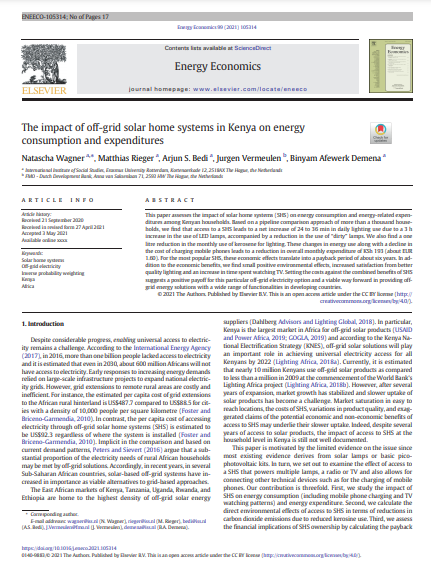
Description: This paper assesses the impact of solar home systems (SHS) on energy consumption and energy-related expenditures among Kenyan households. Based on a pipeline comparison approach of more than a thousand households, it was find that access to a SHS leads to a net increase of 24 to 36 min in daily lighting use due to a 3 h increase in the use of LED lamps, accompanied by a reduction in the use of “dirty” lamps.

            Download Report >>

             Visit Website >>
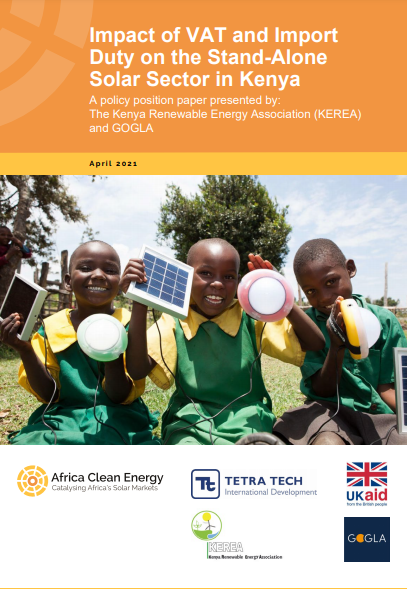
Publication date: 15 April 2021

Author: Tetra Tech

Description: In 2020, the VAT exemptions for Stand-Alone Solar (SAS) products were removed through amendments to the Value Added Tax Act, No. 35 of 2013 that were enacted through the Finance Act, 2020. In addition, the Legal Notice No. EACC/89/2020 removed import duty exemptions for SAS products through amendments to the East African Community Customs Management Act, 2004.

            Download Report >>

             Visit Website >>
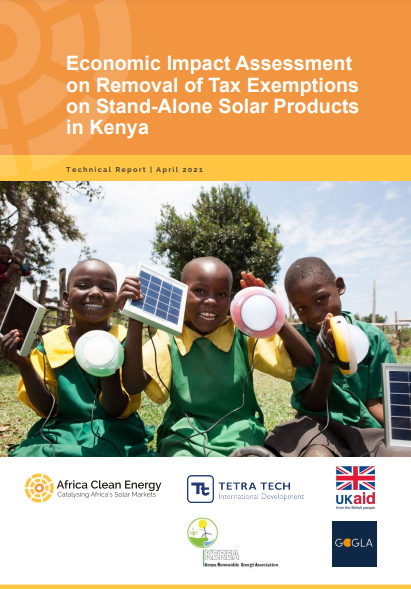
Publication date: 15 April 2021

Author: Tetra Tech

Description: Stand-alone solar products (SAS) play a critical role in delivering electricity access for all, especially for hard-to-reach, low-income Kenyan households. In rural Kenya, only 26% of households have access to the main grid, while 30% rely on SAS technologies as their primary source of lighting. There is still a significant gap to reach the universal access targets in rural areas, where over 40% of the population relies on paraffin, gas lamps, torches, batteries, wood and candles.

            Download Report >>

             Visit Website >>
Publication date: March 2021

Author: Climate Policy Initiative

Description: Kenya is a party to the United Nations Framework Convention on Climate Change (UNFCCC), its Kyoto Protocol, and the Paris Agreement. Over the past five years, considerable efforts have been made to mainstream climate change considerations into the country’s plans, policies, strategies, projects and programmes.

            Download Report >>

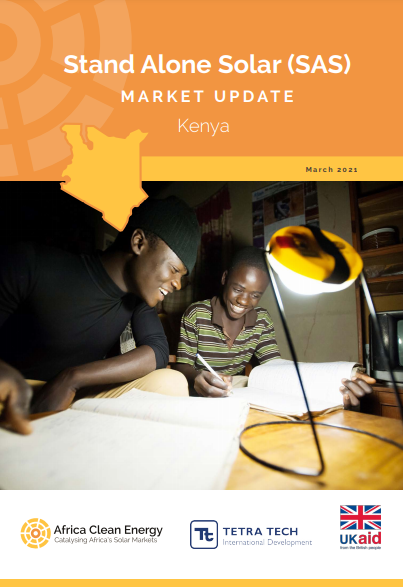
Publication date: March 2021

Author: Tetra Tech International Development

Description: The country will need at least 2.2 million solar home systems (SHS) to achieve universal access by 2022. With the government-led Kenya Off-Grid Solar Access Project (KOSAP) programme expected to provide at least 250,000 SHS by 2023, there is a big potential for the private sector and other players to participate. The pay-as-yougo (PAYG) model also provides another option to help attain the target in a country where mobile penetration is over 90 per cent and at least 95 per cent of households have access to one of the available mobile payment platforms.

            Download Report >>

Publication date: 23 November 2020

Author: African Development Bank

Description: Energy is a critical enabler in reaching development goals. However, the benefits of increased access to modern and cleaner energy services often fail to accrue evenly to  men  and  women.  The  African  Development  Bank  and  ENERGIA  recognise  the  need to prioritise policy action in the field of gender and energy to meet the inter-national Sustainable Development Goals (SDGs). This country brief on gender and energy in Kenya is one in a series to support equality of access and use of energy by women and men through evidence-based initiatives.

            Download Report >>

Publication date: 20 October 2020

Author: MDPI

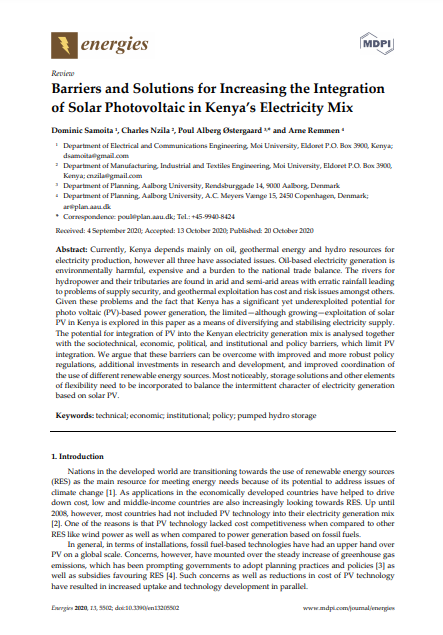
Description: Currently, Kenya depends mainly on oil, geothermal energy and hydro resources for electricity production, however all three have associated issues. Oil-based electricity generation is environmentally harmful, expensive and a burden to the national trade balance. The rivers for hydropower and their tributaries are found in arid and semi-arid areas with erratic rainfall leading to problems of supply security, and geothermal exploitation has cost and risk issues amongst others. Given these problems and the fact that Kenya has a significant yet underexploited potential for photo voltaic (PV)-based power generation, the limited—although growing—exploitation of solar PV in Kenya is explored in this paper as a means of diversifying and stabilising electricity supply.

            Download Report >>


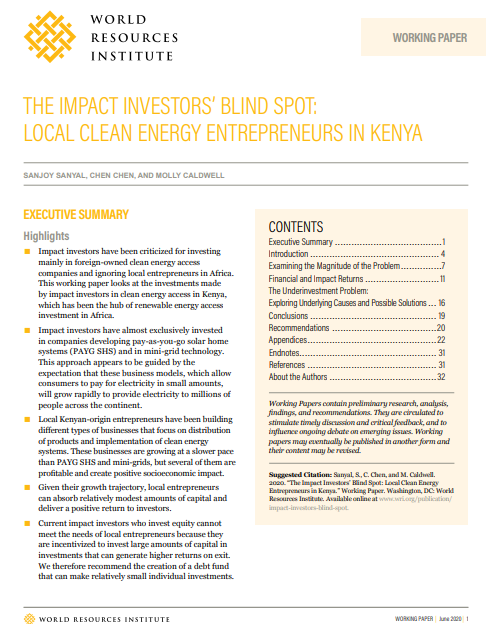
Publication date: June 2020

Author: World Resources Institute

Description: Impact investment aiming at generating both financial and socioeconomic returns is critical to achieve universal energy access. Off-grid energy access companies have absorbed about US$1.7 billion worldwide in disclosed investments in the period 2010 to 2018. The pace of investment has accelerated in the last few years. At the same time, impact investors have been criticized for investing only in foreign-owned companies and not local entrepreneurs, particularly in Africa.

            Download Report >>

            Visit Website >>
 

Publication date: 8 May 2020

Author: Policy Center for the New South

Description: Digital technological innovation, combined with new financing approaches, can make a significant contribution in the field of access to energy. This is the case in Kenya, where payas- you-go solutions, combined with solar home systems and an extensive mobile network, have enabled thousands of Kenyans to access clean and affordable off-grid electricity. This policy paper identifies the drivers of the development of pay-as-you-go solutions in off-grid systems in Kenya, assesses their successes and shortcomings based on two case studies, and develops a set of recommendations to better capitalize on the various opportunities and avoid the potential risks related to the emergence of off-grid pay-as-you-go solutions in developing countries.

            Download Report >>

            Visit Website >>
 

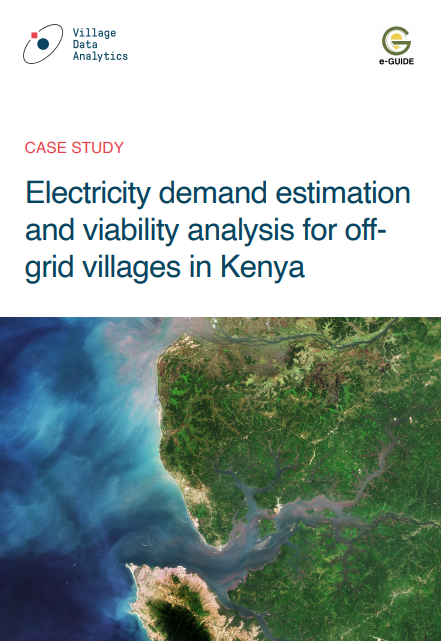
Publication date: 2020

Author: Village Data Analytics

Description: The e-GUIDE “Electricity demand estimation and viability analysis for off-grid villages in Kenya” set out to test innovative data analytical tools to estimate and validate predictions of energy demand in off-grid areas. Data is essential for reliably predicting energy demand, choosing the most cost-efficient electrification solution and to right-size the chosen electricity access solution to ensure the best possible electrification economics. This will help achieve universal access to modern energy both more quickly and in the most cost-efficient manner, enabling scarce infrastructure investment resources to go further.

            Download Report >>

            Visit Website >>


Publication date: December 2019

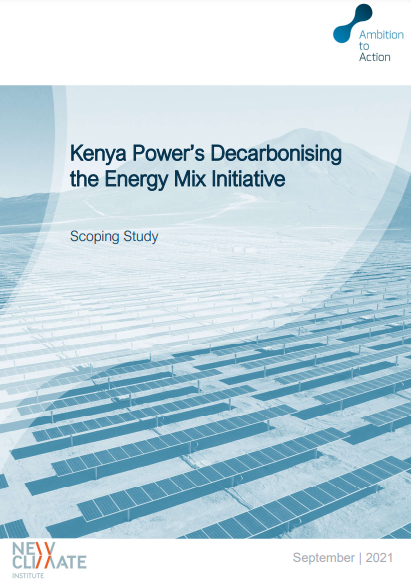
Author: Ambition to Action

Description: The objective of this report is to synthesize the analysis and results from analytical and capacity support activities undertaken as part of the “Ambition to Action” (A2A) project in Kenya between March 2017 and December 2019. The insights aim to inform policy planning in the Kenyan electricity sector and to feed into the discussions around more ambitious climate targets for successive NDCs, aligned with the country’s sustainable development agenda, and the long-term strategy.

            Download Report >>

            Visit Website >>
 

Publication date: 2017

Author: Power Africa

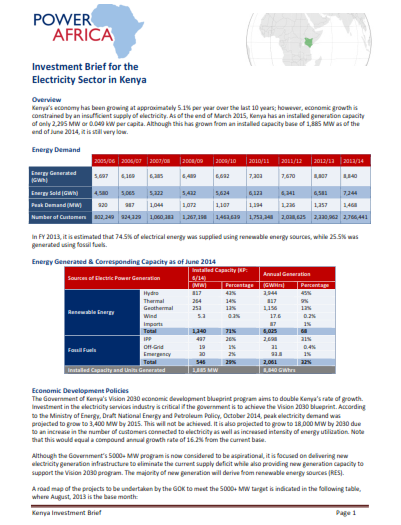
Description: Kenya’s economy has been growing at approximately 5.1% per year over the last 10 years; however, economic growth is constrained by an insufficient supply of electricity. As of the end of March 2015, Kenya has an installed generation capacity of only 2,295 MW or 0.049 kW per capita. Although this has grown from an installed capacity base of 1,885 MW as of the end of June 2014, it is still very low.

            Download Report >>

Publication date: 2016, May

Author: Power Africa

Description: The Kenyan power sector is a true success story in sub-Saharan Africa, with strong leadership at the highest levels of Government, long-standing participation of the private sector in generation, impressive growth in access, and a strong enabling environment for innovation in off-grid solutions.

            Download Report >>

STRATEGIC PARTNERS

Spintelligent
SAAEA
Pennwell
ALER

MEDIA PARTNERS

Renewables Now

EVENT PARTNERS

Africa Energy Forum
Future Energy East Africa
Future Energy Nigeria
Electricx
POWER-GEN Africa
Africa Energy Indaba 2020

Nairobi, KENYA

  • Email: info@africanpowerplatform.org
  • Phone: +254 736 692 876

Newsletter

Search