Publication date: 18 October 2025
Author: Springer
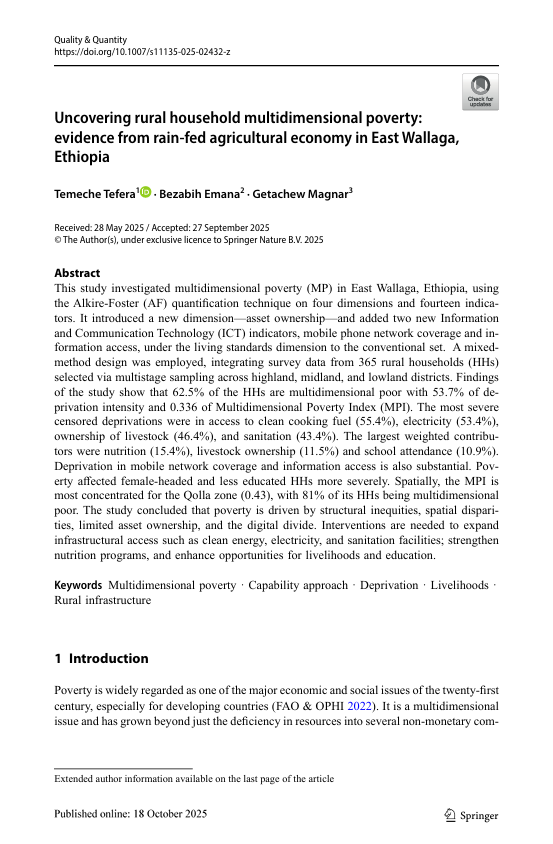
Description: This study investigated multidimensional poverty (MP) in East Wallaga, Ethiopia, using the Alkire-Foster (AF) quantification technique on four dimensions and fourteen indicators. It introduced a new dimension—asset ownership—and added two new Information and Communication Technology (ICT) indicators, mobile phone network coverage and information access, under the living standards dimension to the conventional set. A mixed-method design was employed, integrating survey data from 365 rural households (HHs) selected via multistage sampling across highland, midland, and lowland districts. Findings of the study show that 62.5% of the HHs are multidimensional poor with 53.7% of deprivation intensity and 0.336 of Multidimensional Poverty Index (MPI). The most severe censored deprivations were in access to clean cooking fuel (55.4%), electricity (53.4%), ownership of livestock (46.4%), and sanitation (43.4%). The largest weighted contributors were nutrition (15.4%), livestock ownership (11.5%) and school attendance (10.9%). Deprivation in mobile network coverage and information access is also substantial. Poverty affected female-headed and less educated HHs more severely. Spatially, the MPI is most concentrated for the Qolla zone (0.43), with 81% of its HHs being multidimensional poor. The study concluded that poverty is driven by structural inequities, spatial disparities, limited asset ownership, and the digital divide. Interventions are needed to expand infrastructural access such as clean energy, electricity, and sanitation facilities; strengthen nutrition programs, and enhance opportunities for livelihoods and education.